


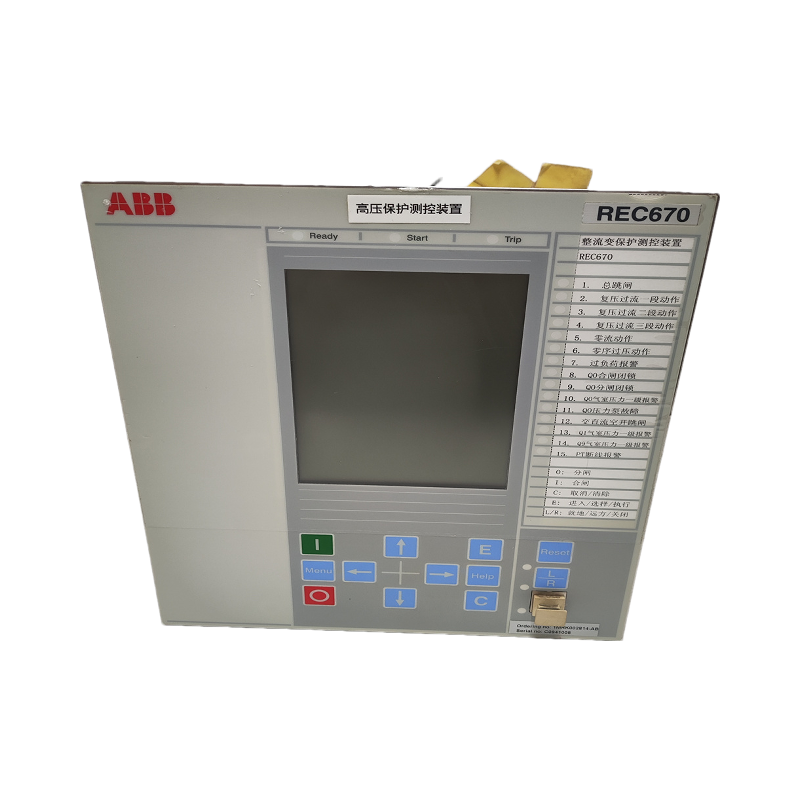
- Mechanical Specifications:
- Design: Compact and modular, with screw terminal connections for easy installation and maintenance.
- Dimensions: Standardized form factor for DIN rail or panel mounting.
- Weight: Approximately 1.2 kg (varies slightly with configuration).
- Environmental Specifications:
- Operating Temperature: -40°C to +70°C (industrial-grade design for harsh environments).
- Storage Temperature: -20°C to +40°C.
- Protection Class: IP45 (dust and splash-resistant).
2. Functional Features
- Core Functions:
- Interval Control: Monitors and manages the “interval” between electrical devices (e.g., circuit breakers, disconnect switches) in substations, ensuring safe and reliable operation.
- Fault Prevention: Detects and isolates faults in power systems, preventing cascading failures.
- Equipment Management: Provides centralized control and monitoring of power equipment, optimizing maintenance schedules.
- Advanced Capabilities:
- Redundancy Support: Features dual CPU and power supply configurations for high availability in critical applications.
- Real-Time Monitoring: Built-in LED indicators display power, communication, and channel status in real time.
- Diagnostics and Adjustment: Supports online diagnostics and parameter adjustment via HMI or engineering software without system downtime.
- Protection Mechanisms:
- Ground Fault Monitoring: Detects ungrounded AC/DC system faults.
- Electrical Isolation: Provides isolation between input/output channels and the system (up to 1,500 V DC).
- Data Handling:
- Fault Recording: Captures and stores fault data for post-event analysis.
- Event Logging: Records operational events for auditing and troubleshooting.
3. Application Scenarios
- Substation Automation:
- Used in medium/high-voltage substations for interval control, fault prevention, and equipment management.
- Ideal for applications with series compensation or HVDC (High-Voltage Direct Current) systems.
- Power Generation and Distribution:
- Applied in thermal, hydro, and renewable power plants for generator synchronization and grid connection control.
- Supports power transmission line monitoring and management.
- Industrial Manufacturing:
- Integrates into production lines for equipment status monitoring, fault diagnosis, and data acquisition.
- Enhances safety and efficiency in automotive, electronics, and machinery manufacturing.
- Building Automation:
- Functions as a door control unit for access management in commercial and industrial facilities.
- Supports card readers, lock outputs, and Wiegand interfaces for secure access control.
4. Supported Industrial Protocols
- Modbus: Supports Modbus RTU/TCP for serial and Ethernet-based communication with SCADA systems, HMIs, and other industrial devices.
- PROFINET: Enables real-time data exchange in industrial Ethernet networks for high-speed control and monitoring.
- EtherNet/IP: Facilitates seamless integration with devices from different manufacturers, adhering to industrial automation standards.
- IEC 61850: Supports IEC 61850-8-1 for station-level bus data communication, enabling interoperability with other intelligent electronic devices (IEDs).
- IEC 60870-5-103: Compatible with IEC 60870-5-103 for legacy system integration.
5. Extensibility & Scalability
- Modular Design:
- Supports integration with additional I/O modules, temperature sensors, and communication interfaces for expanded functionality.
- Each CPU supports up to 4 communication expansion modules for flexible network configurations.
- System Integration:
- Compatible with ABB IndustrialIT 800xA, Symphony Plus, and AC500-eCo systems, enabling easy expansion and upgrades.
- Features standardized interfaces for integration with third-party devices and software.
- Redundancy Options:
- Dual CPU and power supply configurations ensure high availability and fault tolerance in critical applications.
- Software Customization:
- Programmable via ABB Control Builder or System 800xA engineering environments, supporting standard languages like LD, STL, and FBD for tailored control logic.
- Load Grouping:
- Digital input channels enable external signal triggering for automated workflows, while relay outputs support grouping of loads for centralized management.
6. Advantages
- High Reliability: Designed for continuous operation in harsh industrial environments with resistance to vibrations, electromagnetic interference, and temperature fluctuations.
- Flexibility: Modular design and configurable I/O channels adapt to diverse application requirements, from simple monitoring to complex automation tasks.
- Cost Efficiency: Reduces operational costs through energy savings, extended equipment lifespan, and minimized downtime.
- Global Support: Backed by ABB’s extensive technical expertise and global service network for prompt assistance and maintenance.
- Durability: Built to withstand harsh conditions, ensuring long-term reliability and minimal maintenance requirements.
Discover our other products
Sieb & Meyer 44.01.013.1
Sieb & Meyer 44.01.02.5
Sieb & Meyer M7 Servo Control 26.44.18
SIEB&MEYER 0362112EIF
SIEB MEYER 26.50.65 Rev 1
SIEB & MEYER K-259558
SIEB & MEYER 26.45.24
Sieb & Meyer 26.80.45
SIEB & MEYER 26.45.12
Sieb & Meyer AG 021803002X


There are no reviews yet.